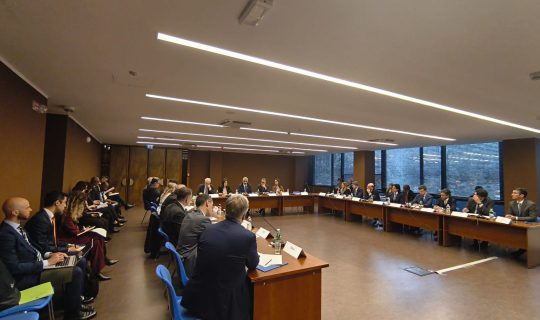
On March 3, 2026, CESI participated in the launch event of the Think Tank Transizione Energetica (TTTE), held at the Istituto di Studi Americani in Rome. The initiative, promoted by CORE in partnership with Enel Foundation, marks the start of a structured analytical process aimed at addressing the infrastructural and regulatory challenges Italy must overcome to achieve its decarbonization objectives.
The event featured the presentation of the report “The State of Renewables in Italy: The Role of Solar PV and Wind Power”, developed by the research team at the Polimi School of Management. The study highlights that the energy transition is far more than a technological evolution: it represents a systemic transformation that requires effective public governance, administrative simplification, stable regulatory frameworks, and a long-term industrial vision capable of supporting investment and innovation.
Within this context, CESI contributed its expertise in technical excellence and infrastructure innovation, focusing on two key pillars for the future of Italy’s power system: grid evolution and quality assurance.
The large-scale deployment of renewable energy sources must be accompanied by a robust reinforcement of transmission and distribution networks. Without adequate grid capacity and flexibility, new renewable installations risk becoming stranded assets. Infrastructure is therefore the essential enabler for integrating variable generation, storage systems, and digital technologies while maintaining system stability and operational security.
Beyond connectivity, CESI stressed the importance of system robustness and compliance. The transition cannot be considered complete simply by installing new capacity; it must ensure that every component of the electrical ecosystem meets the highest international standards in terms of safety, reliability, and performance. Rigorous testing, certification, and standardization processes are fundamental to building a resilient power system capable of withstanding increasing complexity and emerging risks.
For CESI, engineering quality and technical compliance are not optional elements but strategic guarantees of service continuity, investor confidence, and long-term infrastructure protection.
The TTTE initiative will continue in the coming months with the goal of translating research findings into concrete policy and industrial recommendations, reinforcing the role of collaboration among academic institutions, industry stakeholders, and technical partners as the cornerstone of a sustainable and secure energy transition.